Now Reading: Today’s Rocket Launch: A Spectacular Display
-
01
Today’s Rocket Launch: A Spectacular Display
Today’s Rocket Launch: A Spectacular Display

As the launch date approached, public interest in the mission intensified significantly. Pre-launch activities included press conferences, media briefings, and promotional campaigns designed to communicate the mission’s scientific objectives and operational goals to the public. Space industry professionals, researchers, and members of the public gathered at the launch facility and viewing areas to observe the event.
Media organizations provided comprehensive coverage of mission preparations, including interviews with project personnel and documentation of technical procedures. The launch attracted a global audience, with millions of viewers following the event through television broadcasts and online streaming platforms. Launch viewing areas accommodated families and space enthusiasts who traveled to witness the event in person.
The mission represented a continuation of space exploration efforts aimed at advancing scientific understanding and technological capabilities. The launch served as a demonstration of current aerospace engineering achievements and contributed to ongoing research objectives in space science and exploration.
Key Takeaways
- The launch generated significant excitement and anticipation among spectators and experts alike.
- Advanced rocket technology was crucial for the successful deployment of the mission’s payload.
- Multiple organizations and countries collaborated, highlighting the mission’s international importance.
- The launch positively impacted the local community, boosting morale and economic activity.
- Future mission phases promise further advancements and continued technological innovation.
The technical details of the rocket
The rocket itself was a marvel of modern engineering, designed with cutting-edge technology to ensure a successful mission. Standing at an impressive height of 70 meters, it boasted multiple stages, each meticulously crafted to optimize performance and payload capacity. The first stage was powered by a cluster of advanced liquid-fueled engines, capable of generating over 1.5 million pounds of thrust at liftoff.
This immense power was essential for overcoming Earth’s gravitational pull and propelling the rocket into orbit. In addition to its formidable propulsion system, the rocket featured an array of sophisticated avionics and telemetry systems that provided real-time data during flight. These systems monitored critical parameters such as altitude, velocity, and engine performance, allowing mission control to make informed decisions throughout the launch sequence.
The payload fairing, designed to protect the satellite during ascent, was engineered with lightweight composite materials that minimized drag while ensuring structural integrity.
The location and time of the launch
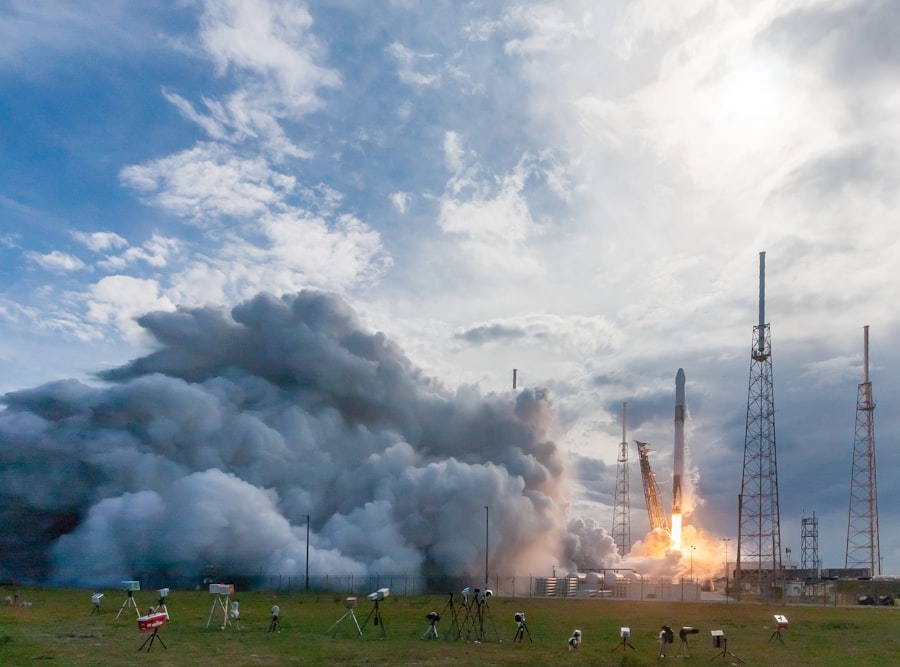
The launch took place at a renowned spaceport located on the coast, strategically chosen for its proximity to open waters and favorable weather conditions. This site had a rich history of successful missions, making it an ideal backdrop for such a significant event. The launch window was meticulously planned for early morning, allowing for optimal visibility as the sun began to rise on the horizon.
This timing not only enhanced the visual spectacle but also aligned with specific orbital mechanics necessary for the mission’s objectives. As dawn broke on launch day, spectators gathered at designated viewing areas, their excitement palpable as they prepared for the momentous occasion. The location offered unobstructed views of the rocket’s ascent, with many attendees equipped with cameras and binoculars to capture every detail.
Local authorities had implemented extensive safety measures to ensure a secure environment for both spectators and personnel involved in the launch operations.
The significance of the mission
This mission held profound significance for various reasons, primarily its potential to advance scientific understanding and technological capabilities. At its core, it aimed to deploy a state-of-the-art satellite designed for Earth observation, capable of monitoring climate change, natural disasters, and urban development with unprecedented accuracy. The data collected would provide invaluable insights for researchers and policymakers alike, enabling informed decision-making in addressing pressing global challenges.
Moreover, this launch symbolized international collaboration in space exploration. It brought together scientists and engineers from multiple countries, each contributing their expertise to achieve a common goal. The mission underscored the importance of unity in tackling complex issues that transcend national borders, fostering a spirit of cooperation that is essential for future endeavors in space exploration.
The involvement of various organizations and countries
| Rocket Name | Launch Time (UTC) | Launch Site | Mission Type | Payload | Launch Status |
|---|---|---|---|---|---|
| Falcon 9 | 14:30 | Cape Canaveral, USA | Satellite Deployment | Starlink Satellites | Scheduled |
| Electron | 18:45 | Mahia, New Zealand | Research Satellite | Scientific Instruments | Scheduled |
| Long March 3B | 22:00 | Xichang, China | Communications Satellite | Beidou Navigation Satellite | Scheduled |
The mission was a collaborative effort involving numerous organizations and countries, each playing a vital role in its success. Leading aerospace companies partnered with governmental space agencies to design and manufacture the rocket and payload. This synergy between public and private sectors exemplified a growing trend in space exploration, where shared resources and expertise can lead to groundbreaking advancements.
Countries from around the globe contributed to different aspects of the mission. For instance, satellite technology was developed by teams in Europe, while propulsion systems were engineered in North America. This international collaboration not only enhanced the technical capabilities of the mission but also fostered goodwill among nations, reinforcing the idea that space exploration is a shared human endeavor.
The crowd’s reaction to the launch

As the countdown reached its final seconds, an audible gasp swept through the crowd gathered at the viewing area. When ignition occurred and flames erupted from the rocket’s engines, cheers erupted from thousands of spectators who had come to witness this historic moment. The roar of the engines reverberated through the air as the rocket ascended into the sky, leaving behind a trail of smoke that slowly dissipated against the backdrop of a clear blue sky.
The emotional response was palpable; many attendees were moved to tears as they witnessed humanity’s ingenuity take flight. Families embraced one another in celebration while children pointed excitedly at the ascending rocket. Social media platforms exploded with live updates and reactions from viewers around the world, amplifying the sense of shared experience that transcended geographical boundaries.
The impact of the launch on the local community
The successful launch had immediate and far-reaching implications for the local community surrounding the spaceport. In addition to generating excitement and pride among residents, it provided an economic boost through increased tourism and local business engagement. Hotels were fully booked as visitors flocked to witness this historic event, while restaurants and shops experienced a surge in patronage from both locals and tourists alike.
Furthermore, educational initiatives were launched in schools across the region to inspire young minds about science and technology. Local organizations collaborated with educational institutions to host workshops and seminars aimed at fostering interest in STEM (Science, Technology, Engineering, Mathematics) fields among students. This ripple effect not only enriched the community’s cultural fabric but also laid the groundwork for future generations to pursue careers in aerospace and related industries.
The successful deployment of the payload
Following a flawless ascent into orbit, the rocket successfully deployed its payload—a sophisticated satellite designed for Earth observation—into its designated trajectory. This moment marked a significant milestone in the mission’s timeline and was met with jubilation from mission control personnel who had worked tirelessly for years in preparation for this day. The satellite’s deployment was executed with precision; it separated from its launch vehicle at precisely calculated intervals to ensure optimal positioning.
Once in orbit, initial telemetry data confirmed that all systems were functioning as intended. The satellite began its calibration process, preparing its instruments for data collection that would commence shortly thereafter. This successful deployment not only validated years of research and development but also set in motion a new era of data-driven insights into our planet’s changing environment.
The future implications of the mission
The implications of this mission extend far beyond its immediate success; it represents a pivotal moment in our understanding of Earth systems and our ability to respond to global challenges. The satellite’s advanced sensors will provide critical data on climate patterns, natural disasters, and urbanization trends—information that can inform policy decisions aimed at mitigating environmental impacts. Moreover, this mission serves as a stepping stone for future endeavors in space exploration.
It demonstrates that international collaboration can yield remarkable results while fostering innovation across borders. As nations continue to work together on similar projects, we can expect advancements in technology that will further enhance our capabilities in space exploration and Earth monitoring.
The role of technology in making the launch possible
The successful execution of this mission was made possible by advancements in technology across various domains. From propulsion systems that utilize cutting-edge materials to avionics capable of processing vast amounts of data in real-time, every aspect of the rocket was designed with precision engineering in mind. Innovations such as 3D printing allowed for rapid prototyping of components while reducing costs associated with traditional manufacturing methods.
Additionally, advancements in satellite technology have enabled more sophisticated instruments capable of capturing high-resolution imagery and data across multiple wavelengths. These technologies are crucial for monitoring environmental changes and providing actionable insights for researchers and policymakers alike.
The next steps for the mission and what to expect next
In the aftermath of this successful launch, several key steps lie ahead for both mission operators and stakeholders involved in utilizing satellite data. First and foremost is ongoing monitoring of satellite performance; engineers will analyze telemetry data to ensure all systems are functioning optimally during initial operations.
Collaborations between scientists across disciplines will be essential as they work together to interpret this data effectively. In conclusion, this historic launch not only marked a significant achievement in aerospace engineering but also underscored humanity’s collective ambition to explore beyond our planet while addressing pressing global challenges through collaboration and innovation. As we look toward future missions inspired by this success story—one can only imagine what new frontiers await us among the stars.
Today marks an exciting milestone in space exploration with the scheduled rocket launch, which aims to advance our understanding of the universe. For those interested in how national events can influence public interest in space missions, you might find it intriguing to read about the significance of federal holidays in America. Check out this related article on the topic: May Federal Holiday: A Day of Remembrance and Celebration.
FAQs
What is the rocket launch scheduled for today?
The rocket launch today refers to a planned mission where a rocket is being launched from a designated spaceport or launch site. The specific details depend on the mission, such as the rocket type, payload, and destination.
What time is the rocket launch happening today?
The exact time of the rocket launch varies depending on the mission schedule and location. Launch times are usually announced by the space agency or company conducting the launch and can be found on their official websites or social media channels.
Where is the rocket launch taking place?
Rocket launches can take place at various spaceports around the world, such as Kennedy Space Center in Florida, Baikonur Cosmodrome in Kazakhstan, or Vandenberg Space Force Base in California. The launch location is typically specified in the mission details.
What is the purpose of today’s rocket launch?
The purpose of a rocket launch can vary widely, including deploying satellites, resupplying the International Space Station, conducting scientific experiments, or testing new rocket technology.
Can the public watch the rocket launch live?
Many rocket launches are streamed live online by the organizations responsible for the launch. Public viewing in person depends on the launch site’s accessibility and safety regulations.
What type of rocket is being launched today?
The type of rocket depends on the mission and the organization conducting the launch. Common rockets include SpaceX’s Falcon 9, United Launch Alliance’s Atlas V, or NASA’s Space Launch System.
What happens if the rocket launch is delayed or scrubbed?
If a launch is delayed or scrubbed, it is usually due to weather conditions, technical issues, or safety concerns. The launch will be rescheduled, and updates are provided by the launch provider.
Is the rocket launch today manned or unmanned?
Rocket launches can be either manned (carrying astronauts) or unmanned (carrying cargo or satellites). The mission details specify whether the launch includes a crew.
How can I find more information about today’s rocket launch?
More information can be found on the official websites and social media pages of the space agency or company conducting the launch, as well as through news outlets covering space events.